Key Considerations for Foreign Investors in M&A Transactions with Korean Companies (May 2024, ABA IMAJV Newsletter)
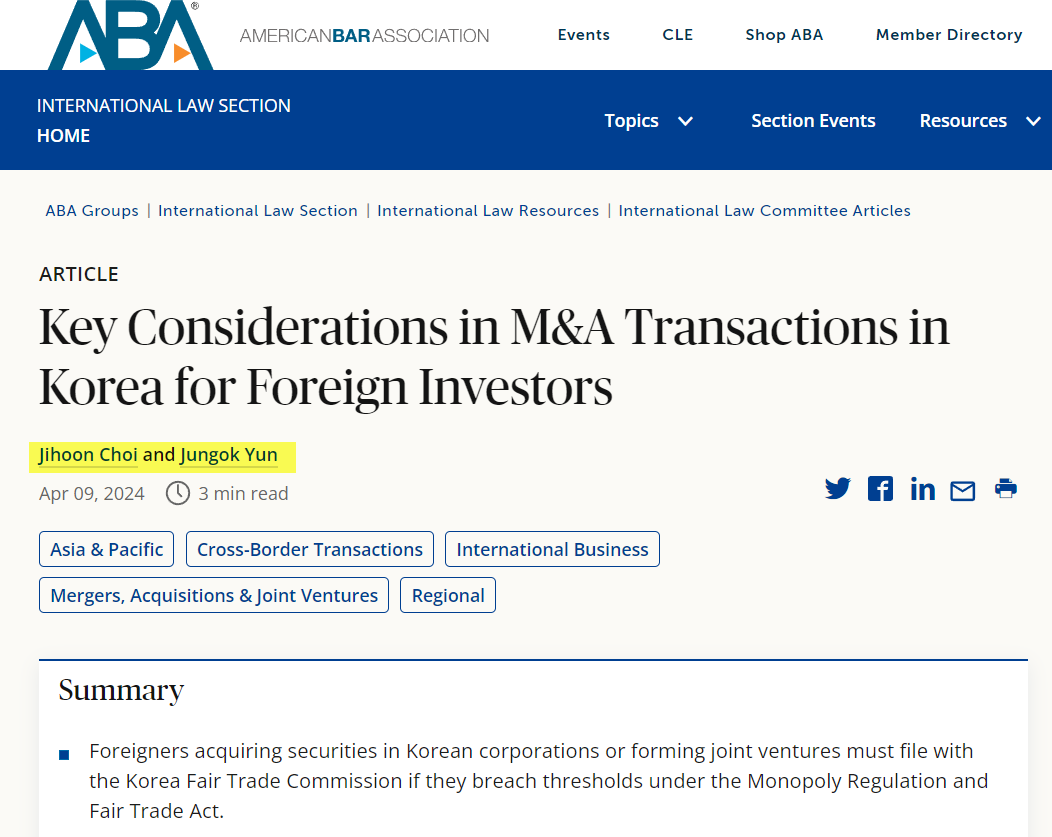
Attorney Jungok Yun and Senior Foreign Attorney Jihoon Choi of SEUM have contributed an article titled "Key Considerations in M&A Transactions in Korea for Foreign Investors" to the 2024 edition of the newsletter published by the International Mergers and Acquisitions and Joint Ventures Committee(IMAJV Committee) of the American Bar Association International Law Section(ABA ILS).
The ABA ILS, a division of the world's largest lawyers' association, the American Bar Association (ABA), connects international legal practitioners from the U.S. and around the world, providing legal education programs and publishing books and resources for international legal professionals.
The IMAJV Committee, a subset of the ABA ILS, comprises over 340 members globally, who actively communicate and research international M&A and JV-related legal topics.
(Link 1)
(Link 2)

The newsletter published by the IMAJV Committee includes contributions from experts in various countries, offering in-depth discussions on the latest information on cross-border M&A and joint ventures. The 2024 edition features 27 experts from 14 countries, including Brazil, Chile, China, the Dominican Republic, El Salvador, India, Korea, Nigeria, Poland, Russia, Spain, the U.S., Uruguay, and Vietnam.
In their contribution, SEUM's Jungok Yun and Jihoon Choi detailed the key considerations for foreign investors acquiring shares in Korean companies or establishing joint ventures with Korean companies. The article covers procedural and strategic topics such as 'corporate combination report,' 'foreign exchange report,' and 'basic considerations for preparing for management disputes.'

Attorney Yun and Senior Foreign Attorney Choi emphasized that the most crucial step in preparing for management disputes is the 'appointment of a CEO.' They explained, "For Korean companies with capital exceeding 1 billion KRW, it is mandatory to appoint at least three directors to form a board, and one of these directors must be appointed as CEO. If the appointed CEO refuses to convene a board meeting or a shareholders' meeting at the request of a foreign investor, it can be challenging for the foreign shareholder to assert their intentions, often requiring a court ruling."
*The full article can be found on pages 20-22 of the newsletter and on the ABA website (accessible to ABA members only).